What is an Agile Mindset?
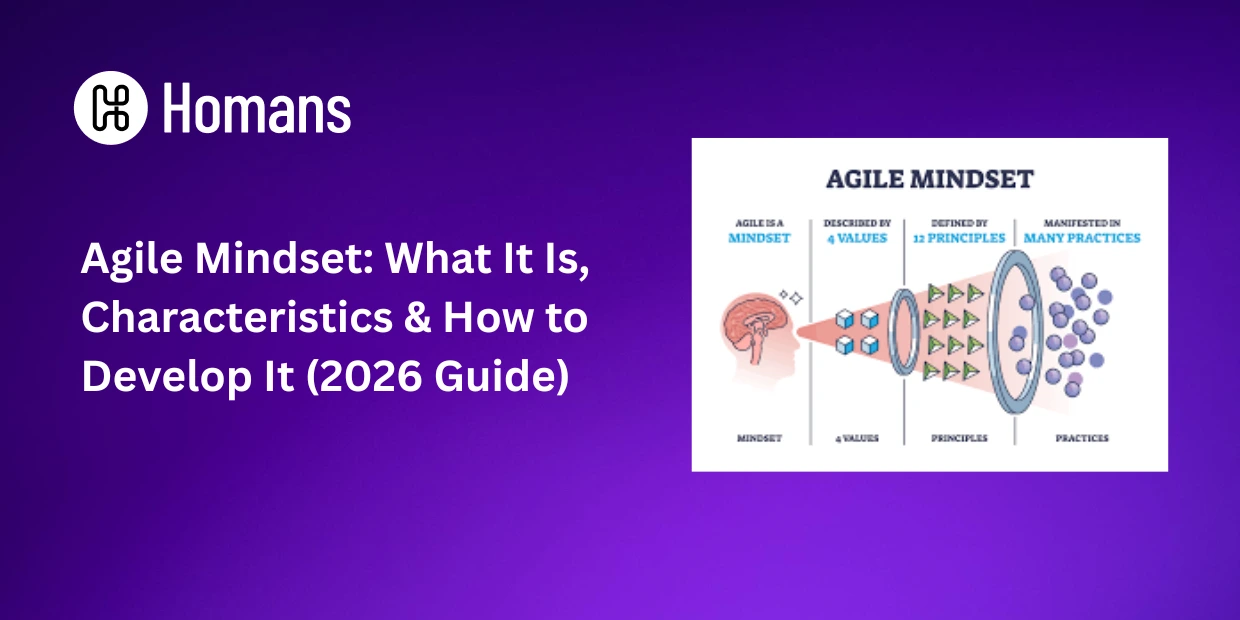
An agile mindset is a set of attitudes, values, and behaviors that enable individuals and teams to respond effectively to change, embrace continuous learning, and deliver value in dynamic environments. Unlike agile methodologies (Scrum, Kanban) which are external frameworks, the agile mindset represents the internal cognitive and cultural shift that makes these practices truly effective.
Agile Mindset Definition
According to recent research from organizational psychology, an agile mindset can be defined as:
“An attitude that equates failure and problems with opportunities for learning, emphasizes collaboration over individual achievement, values customer feedback over rigid planning, and prioritizes adaptation over adherence to predetermined paths.”
— Journal of Managerial Psychology, 2025
The Four Core Pillars of Agile Mindset
1. Flexibility
Flexibility is the ability to pivot quickly when circumstances change without losing momentum. An agile mind doesn’t just react to change it anticipates and prepares for multiple scenarios. This means maintaining several solution pathways simultaneously and being comfortable with ambiguity.
2. Adaptability
While flexibility is about having options, adaptability is about successfully implementing those options. Adaptability involves reconfiguring resources, adjusting approaches, and applying lessons learned from previous iterations to new challenges. Research shows that adaptable teams are 30-35% more productive than rigid ones.
3. Iteration
Iteration embodies the philosophy of continuous improvement through repeated cycles of experimentation, learning, and refinement. Rather than seeking perfection on the first attempt, an agile mindset values rapid prototyping, feedback incorporation, and incremental enhancement. This approach reduces risk and accelerates learning.
4. Collaboration
Collaboration in an agile context goes beyond simply working together. It requires psychological safety, transparent communication, collective ownership of outcomes, and the ability to leverage diverse perspectives. Studies from 2024 show that 59% of agile practitioners report enhanced collaboration as a primary benefit.
The Science Behind Agile Mindset: Latest Research Findings
Groundbreaking 2024-2025 Research
Recent empirical studies have validated the agile mindset as a distinct psychological construct with measurable impacts:
Study 1: Organizational Psychology Validation (2025)
A two-wave study with 411 participants published in the Journal of Managerial Psychology demonstrated that agile mindset:
- Positively predicts job performance beyond established traits like core self-evaluation
- Enhances innovative work behavior independent of proactive personality
- Increases vigor and reduces emotional exhaustion at work
- Shows discriminant validity from related concepts like learning agility and psychological empowerment
Study 2: Information Systems Research (2025)
A systematic literature review analyzing 62 research papers identified four key areas where agile mindset proves essential:
- Implementing agile methods during organizational transformations
- Driving digital transformation and technology adoption
- Supporting coaching, training, and education initiatives
- Enabling agile leadership and management practices
Study 3: Tacit Knowledge Mastery (2025)
Research on agile mindset leaders revealed they possess a “hybrid mindset” that masters ambidexterity simultaneously balancing:
- Stability and agility
- Experimentation and exploitation
- Flexibility and control
- Innovation and efficiency
The Neuroscience Connection
Emerging neuroscience research suggests that agile mindsets correlate with enhanced cognitive flexibility in the prefrontal cortex, allowing for faster mental switching between tasks and better adaptation to novel situations.
Key Characteristics of an Agile Mindset
Individual-Level Characteristics
1. Willingness to Learn
An agile mind exhibits insatiable curiosity and actively seeks new knowledge. This goes beyond passive information consumption to active application and experimentation. Employees with this trait view every project as a learning opportunity and regularly step outside their comfort zones.
Practical indicators:
- Regularly asks “why” and “what if” questions
- Voluntarily takes on unfamiliar tasks
- Shares lessons learned proactively
- Maintains a growth mindset about capabilities
2. Advanced Problem-Solving Abilities
Agile problem-solvers approach challenges systematically yet creatively. They decompose complex problems, identify root causes, generate multiple solutions, and evaluate trade-offs effectively. Research shows this capability increases by 93% in agile environments compared to traditional settings.
3. Results Orientation & Initiative
High agency characterizes the agile mindset. These individuals don’t wait for direction they identify opportunities, propose solutions, and drive outcomes. They measure success by impact, not effort, and take ownership of results whether positive or negative.
4. Cognitive Ability
Abstract thinking, pattern recognition, and systems thinking enable agile individuals to navigate complexity. They see connections others miss, anticipate second-order effects, and design solutions that address systemic issues rather than symptoms.
5. Emotional Intelligence Components
Agreeableness: Understanding and prioritizing others’ needs while maintaining healthy boundaries
Extraversion: Bringing positive energy and enthusiasm to collaborative efforts without dominating
Emotional Stability: Remaining composed under pressure, managing stress effectively, and bouncing back from setbacks quickly
Openness: Embracing new experiences, diverse perspectives, and unconventional approaches
Team-Level Characteristics
1. Psychological Safety
Teams with agile mindsets create environments where members feel safe to take risks, admit mistakes, ask questions, and challenge ideas without fear of embarrassment or retaliation. Google’s Project Aristotle identified this as the single most important factor in team effectiveness.
2. Shared Mental Models
Agile teams develop common understanding of goals, processes, and each other’s capabilities. This reduces coordination costs and enables rapid, decentralized decision-making.
3. Collective Learning
Rather than individual knowledge hoarding, agile teams implement systematic knowledge sharing through pair programming, retrospectives, documentation, and cross-training.
Organizational-Level Characteristics
1. Customer Focus
Organizations with agile mindsets obsess over customer value. They measure success by customer satisfaction and outcomes rather than output or activity metrics. This manifests in regular customer feedback loops, user research, and outcome-based roadmaps.
2. Transparency & Trust
Information flows freely across levels and functions. Decision-making processes are visible. Mistakes are treated as learning opportunities. Trust replaces control as the primary coordination mechanism.
3. Continuous Improvement Culture
Agile organizations institutionalize learning through retrospectives, experimentation budgets, innovation time, and celebration of intelligent failures. They measure and optimize cycle time, quality, and value delivery systematically.
4. Decentralized Decision-Making
Authority is pushed to the edges of the organization where information exists. Teams have autonomy within clear constraints. Bureaucracy is minimized in favor of principles and outcomes.
Why Agile Mindset Matters: Business Impact & ROI
Quantifiable Business Benefits
Performance Improvements
Research from multiple studies demonstrates remarkable improvements:
- 10-20% improvement in revenue, quality, and cycle time
- 30-35% productivity increase in agile teams vs. traditional teams
- 54-61% cost reduction through operational efficiency
- 50-60% reduction in time-to-market
- 93% quality improvement through iterative development
- 250% increase in product quality for full Scrum implementations
Financial Returns
University of Maryland research found agile projects deliver:
- 11x greater ROI compared to traditional projects
- 11x higher Net Present Value (NPV)
- 13x higher Real Options Analysis (ROA) value
- 7x earlier breakeven point
- 20x more productive teams
Customer & Employee Impact
- 93% of organizations report higher customer satisfaction
- 20-30 point increase in customer satisfaction scores
- 20-30 point increase in employee engagement
- 59% report enhanced collaboration
- 57% note better business alignment
Competitive Advantage
Market Responsiveness
Companies with agile mindsets can:
- Respond to market changes 70% faster
- Launch products 50-60% quicker
- Iterate based on customer feedback in days vs. months
- Capture emerging opportunities before competitors
Innovation Capacity
Agile mindsets directly correlate with innovation:
- Teams report 39% improvement in innovative work behavior
- Organizations with agile cultures patent 2-3x more innovations
- Failed experiments cost 60% less due to early feedback
- Innovation success rates improve by 40-50%
Risk Mitigation
Project Success Rates
- Agile projects have a 9% failure rate vs. 29% for traditional waterfall projects
- Organizations achieve 75%+ project success rates with agile methods
- Cost overruns reduce by 40-60%
- Scope creep decreases by 50% through iterative delivery
Organizational Resilience
McKinsey research on COVID-19 pandemic responses found:
- Agile organizations demonstrated superior resilience
- Higher adaptability to remote work transitions
- Faster recovery in customer satisfaction metrics
- Better employee engagement during crisis periods
How to Identify Agile Mindset in Employees
Behavioral Indicators During Interviews
Situation-Based Questions
Ask candidates to describe:
- Adaptation example: “Tell me about a time when project requirements changed significantly mid-stream. How did you respond?”
- Look for: Flexibility, solution orientation, minimal defensiveness, learning mindset
- Collaboration scenario: “Describe a situation where your team had conflicting opinions. What was your role?”
- Look for: Active listening, perspective-taking, consensus-building, constructive conflict
- Learning instance: “When did you recently fail at something? What did you learn?”
- Look for: Ownership, reflection, applied learning, growth mindset
- Initiative demonstration: “Give an example of when you identified and solved a problem nobody asked you to solve.”
- Look for: Proactivity, results orientation, independent thinking
Observable Workplace Behaviors
Daily Indicators
Employees with agile mindsets typically:
- Ask clarifying questions before jumping to solutions
- Volunteer for cross-functional projects
- Share credit for successes, take ownership of failures
- Propose experiments rather than demanding resources for untested ideas
- Adapt communication styles for different audiences
- Seek feedback actively and non-defensively
- Document and share learnings from projects
- Help others without being asked
Red Flags (Fixed Mindset Indicators)
- “That’s not my job” mentality
- Resistance to feedback or criticism
- Blame-oriented explanations for failures
- Rigid adherence to processes over outcomes
- Hoarding information or knowledge
- Avoiding new or challenging tasks
- Defensive reactions to change announcements
Assessment Tools & Frameworks
1. Agile Mindset Self-Assessment
Evaluate on a 1-5 scale:
Learning Agility
- I actively seek feedback on my work
- I view failures as learning opportunities
- I regularly experiment with new approaches
- I can quickly learn and apply new concepts
Collaboration
- I proactively share knowledge with teammates
- I am comfortable with constructive conflict
- I value diverse perspectives
- I prioritize team success over individual recognition
Adaptability
- I stay calm when plans change unexpectedly
- I can work effectively with ambiguous requirements
- I adjust my approach based on new information
- I am comfortable with iterative, non-linear work
Customer Focus
- I regularly consider end-user needs
- I seek customer feedback proactively
- I prioritize features by customer value
- I measure success by customer outcomes
2. 360-Degree Feedback
Collect input from:
- Direct reports (for managers)
- Peers across functions
- Supervisors
- Cross-functional partners
3. Behavioral Observation During Trial Projects
Assign candidates to:
- Time-boxed hackathons
- Cross-functional problem-solving sessions
- Pair programming or collaborative tasks
- Retrospective facilitation
Continuous Assessment Methods
Performance Indicators
Track over time:
- Velocity of learning new skills
- Quality of peer knowledge sharing
- Speed of adaptation to new tools/processes
- Effectiveness in ambiguous situations
- Constructive conflict resolution instances
- Initiative-taking frequency
Retrospective Participation
Evaluate:
- Quality of insights contributed
- Openness to feedback
- Implementation of improvement actions
- Support for team experiments
Developing an Agile Mindset: Practical Frameworks
Individual Development Strategies
1. The Growth Mindset Foundation
Based on Carol Dweck’s research, agile mindset development starts with believing capabilities can be developed:
Daily practices:
- Replace “I can’t do this” with “I can’t do this yet“
- Celebrate learning over performance
- Analyze failures for specific learnings
- Seek challenges that stretch current abilities
2. Experimentation Habit Building
Framework: The 70-20-10 Rule
Allocate time:
- 70% on core responsibilities (apply agile principles)
- 20% on stretch assignments (develop new capabilities)
- 10% on experiments (test new ideas)
Implementation:
- Set weekly learning goals
- Document experiments and outcomes
- Share learnings with team
- Celebrate intelligent failures
3. Feedback Loops
The Retrospective Mindset
After every significant task, ask:
- What went well? (reinforce)
- What didn’t go well? (learn)
- What will I do differently? (apply)
- What help do I need? (collaborate)
Feedback seeking protocol:
- Request specific, actionable feedback weekly
- Create psychological safety for honest input
- Act on at least one piece of feedback monthly
- Report back on implementations
Team Development Strategies
1. Psychological Safety Building
Practical actions:
- Leader admits mistakes first in retrospectives
- Celebrate intelligent failures publicly
- Implement “no blame” incident reviews
- Create explicit space for questions and challenges
- Model vulnerability and learning
2. Collaborative Rituals
Daily Standups (15 minutes)
Purpose: Synchronize, surface blockers, foster collaboration
- What I accomplished yesterday
- What I’m working on today
- What’s blocking me
Sprint Retrospectives (90 minutes)
Format:
- What went well? (collect)
- What didn’t go well? (collect)
- Generate insights (analyze)
- Create action items (commit)
- Review previous actions (accountability)
3. Cross-Training Programs
Pair Programming / Working
Benefits:
- Real-time knowledge transfer
- Quality improvement through peer review
- Relationship building
- Reduced knowledge silos
Rotation Programs
Temporarily assign team members to:
- Different functional roles
- Customer-facing positions
- Leadership responsibilities
- Cross-functional projects
Organizational Development Strategies
1. Leadership Modeling
Leaders must embody agile mindset first:
Behaviors to model:
- Admit uncertainty and ask for input
- Change course based on data
- Share decision-making rationale
- Celebrate learning from failures
- Prioritize long-term capability over short-term results
2. Structure & Systems Alignment
Remove barriers:
- Simplify approval processes
- Delegate authority to teams
- Reduce handoffs and dependencies
- Eliminate non-value-adding reporting
Enable agility:
- Create dedicated innovation time (Google’s 20% time)
- Fund small experiments (fail fast budgets)
- Establish cross-functional teams
- Implement OKRs for outcome focus
3. Culture Transformation Roadmap
1: Pilot (3-6 months)
- Select motivated team(s)
- Train in agile principles
- Implement basic rituals
- Measure and showcase results
2: Expand (6-12 months)
- Scale to additional teams
- Create community of practice
- Train agile coaches
- Align HR systems
3: Embed (12-24 months)
- Update organizational structure
- Align incentives and metrics
- Integrate into hiring/promotion
- Make agile the default
4. Training & Development Programs
Foundational Training
- Agile principles workshop (2 days)
- Scrum master certification
- Product owner training
- Agile coaching skills
Advanced Development
- Systems thinking
- Facilitation mastery
- Conflict resolution
- Scaled agile frameworks (SAFe, LeSS)
Agile Mindset in Different Contexts
Agile Mindset in Leadership
Characteristics of Agile Leaders
Agile leaders demonstrate:
Servant leadership: Removing obstacles rather than directing work
Empowerment: Trusting teams with autonomy within clear boundaries
Adaptability: Adjusting strategy based on feedback and changing conditions
Vulnerability: Admitting mistakes and modeling continuous learning
Systems thinking: Optimizing for whole system performance, not local optimization
Research findings (2024):
A study on digital transformation found agile leaders drive success through:
- Fast decision loops (reducing decision time by 60%)
- Continuous participation in transformation activities
- Evolutionary and revolutionary practices
- Making organizations leaner and more efficient
Organizations with agile leadership reported:
- Employees feeling part of decision-making processes
- Increased overall morale
- Stronger connection to company future
- Higher engagement in transformation projects
Agile Mindset in Remote/Hybrid Work
Adaptation requirements:
Communication intensity: Over-communicate in asynchronous environments
Documentation discipline: Write down what would be whiteboard conversations
Trust building: Extra effort to build relationships virtually
Tool proficiency: Master collaboration tools deeply
Flexibility: Accommodate different time zones and working styles
Best practices:
- Daily async updates via Slack/Teams
- Weekly video retrospectives
- Bi-weekly pair programming sessions
- Monthly virtual social events
- Transparent documentation in shared spaces
Agile Mindset in Government & Public Sector
Research on German public administrations (2024) identified three translation modes:
1. Agile as Culture
Emphasis on:
- Trust and appreciation
- Employee empowerment
- Feedback culture
- Positive error culture
2. Agile as Governance
Focus on:
- Cross-functional collaboration
- Breaking down silos
- Iterative service delivery
- Citizen feedback loops
3. Agile as Methodology
Implementation of:
- Scrum ceremonies
- Sprint planning
- User stories
- Incremental delivery
Challenges specific to public sector:
- Rule-oriented bureaucracies
- Compliance requirements
- Political cycles
- Change resistance
- Legacy systems
Solutions:
- Start with cultural concepts
- Pilot with willing teams
- Demonstrate quick wins
- Align with digitalization mandates
Agile Mindset in Marketing
86% of marketing leaders plan to transition teams to agile methodologies. Current applications include:
Campaign management:
- Sprint-based campaign development
- Rapid testing of creative variations
- Data-driven iteration
- Cross-functional campaign teams
Content creation:
- Editorial sprints
- Feedback incorporation loops
- Performance-based prioritization
- Collaborative content calendars
Benefits reported:
- Faster campaign launches (40-50% reduction)
- Better alignment with sales
- Improved responsiveness to market changes
- Higher employee morale and creativity
Common Challenges & Solutions
Challenge 1: Resistance to Change
Manifestations:
- “We’ve always done it this way”
- Passive compliance without engagement
- Reversion to old habits under pressure
- Cynicism about “another initiative”
Root causes:
- Fear of incompetence with new methods
- Loss of status or expertise
- Previous change initiative failures
- Lack of understanding of “why”
Solutions:
Create urgency: Present compelling data on competitive threats or market changes
Involve resisters: Give skeptics meaningful roles in design and implementation
Start small: Pilot with volunteers, showcase results, then expand
Address fears directly: Provide training, coaching, and support
Celebrate early wins: Publicize successes from pilot teams
Challenge 2: Leadership Not Walking the Talk
Manifestations:
- Leaders demand agility while maintaining command-and-control
- Executive reviews that penalize experimentation
- Resource allocation that prioritizes certainty over learning
- Micromanagement despite autonomy rhetoric
Solutions:
Executive coaching: Help leaders develop agile leadership capabilities
360 feedback: Create visibility into leadership behaviors
Behavioral commitments: Leaders publicly commit to specific agile behaviors
Leading by example: Start agile transformation with executive team
Accountability: Tie leadership performance to agile culture metrics
Challenge 3: Scaling Beyond Pilot Teams
Manifestations:
- Pilot success doesn’t translate to broader organization
- Dependencies between agile and non-agile teams create friction
- Agile teams become isolated “special forces”
- Organizational systems contradict agile principles
Solutions:
Communities of practice: Connect agile practitioners across teams
Scaled frameworks: Implement SAFe, LeSS, or other coordination mechanisms
System alignment: Update budgeting, planning, HR processes
Cross-team dependencies: Create forums for alignment and coordination
Gradual expansion: Scale thoughtfully rather than rushing
Challenge 4: Maintaining Agility in Regulated Industries
Manifestations:
- Compliance requirements seem incompatible with iteration
- Risk aversion prevents experimentation
- Documentation needs conflict with working software priority
- Approval processes slow down delivery
Solutions:
Compliance automation: Build regulatory requirements into CI/CD pipelines
Risk-based approach: Apply agility to low-risk areas first
Regulatory engagement: Involve compliance experts in sprint planning
Documentation as code: Automate compliance documentation
Industry examples: Learn from successful agile banks and healthcare providers
Challenge 5: Measuring the “Soft” Aspects
Manifestations:
- Difficulty quantifying mindset changes
- Focus remains on activity metrics (velocity) vs. outcomes
- Lack of leading indicators for cultural shift
- Executive skepticism about intangible benefits
Solutions:
Behavioral indicators: Track specific observable behaviors
Pulse surveys: Regular short surveys on psychological safety, collaboration
Qualitative + quantitative: Combine numerical metrics with narratives
Business outcome metrics: Connect agile practices to business KPIs
Maturity assessments: Regular agile maturity evaluations
Measuring Agile Mindset Success
Leading Indicators (Early Signals)
Team-Level Metrics
- Psychological Safety Score
- Anonymous survey question: “I feel safe taking risks on this team” (1-5 scale)
- Target: 4.0+ average, improving over time
- Knowledge Sharing Frequency
- Track: Pair programming hours, documentation contributions, lunch & learns
- Target: 20% increase quarter-over-quarter
- Retrospective Action Implementation Rate
- Calculate: % of retrospective actions completed by next retro
- Target: 70%+ completion rate
- Cross-Training Participation
- Measure: % of team members learning skills outside primary role
- Target: 50%+ annually
Individual-Level Metrics
- Learning Velocity
- Track: New skills/tools mastered per quarter
- Survey: Self-assessment + peer validation
- Feedback Seeking Behavior
- Count: Instances of actively requesting feedback
- Target: Weekly feedback requests
- Experiment Initiation
- Measure: Number of small experiments proposed/conducted
- Target: 1-2 per team member per sprint
Lagging Indicators (Outcome Measures)
Business Performance
- Time to Market
- Measure: Days from idea to production
- Target: 30-50% reduction year-over-year
- Customer Satisfaction (NPS/CSAT)
- Track: Net Promoter Score, Customer Satisfaction Score
- Target: 10-30 point increase
- Quality Metrics
- Monitor: Defect rates, customer-reported issues, rework percentage
- Target: 40-50% reduction
- Innovation Output
- Count: New features shipped, patents filed, new products launched
- Target: 2-3x increase
- Employee Engagement
- Survey: eNPS, engagement scores, retention rates
- Target: 20-30 point improvement
Financial Performance
- ROI
- Calculate: (Benefits – Costs) / Costs × 100
- Target: 200-300% ROI on agile transformation
- Cost Efficiency
- Measure: Cost per feature, operational costs
- Target: 30-60% cost reduction
- Revenue Growth
- Track: Year-over-year revenue growth, new customer acquisition
- Target: 10-20% improvement
Assessment Frameworks
Agile Maturity Model
1: Initial
- Ad-hoc processes
- Individual heroics
- Unpredictable results
2: Managed
- Basic agile practices adopted
- Team-level implementation
- Some process discipline
3: Defined
- Standardized processes across teams
- Organizational support structures
- Consistent practices
4: Quantitatively Managed
- Metrics-driven improvement
- Statistical process control
- Predictable performance
5: Optimizing
- Continuous innovation
- Proactive improvement
- Sustainable competitive advantage
Quarterly Assessment Template
Rate each dimension 1-5:
Mindset & Culture (25%)
- Psychological safety
- Learning orientation
- Customer focus
- Collaboration quality
Practices & Processes (25%)
- Agile ceremony effectiveness
- Iteration speed
- Feedback loop efficiency
- Cross-functional coordination
Outcomes & Results (25%)
- Business value delivered
- Customer satisfaction
- Quality metrics
- Innovation output
Capabilities & Skills (25%)
- Agile competency levels
- Role proficiency
- Tool mastery
- Coaching capability
FAQs
What is an agile mindset in simple terms?
An agile mindset is a way of thinking that embraces change, values continuous learning, prioritizes collaboration, and focuses on delivering customer value through iterative improvement. It’s about being flexible, adaptable, and always looking for ways to improve.
How is agile mindset different from agile methodology?
Agile methodologies (Scrum, Kanban, XP) are the external frameworks and practices teams follow. Agile mindset is the internal belief system, attitudes, and values that make those practices effective. You can follow agile practices without having an agile mindset, but true agility requires both.
What does it mean to have an agile mind?
Having an agile mind means being mentally flexible, able to quickly switch between different tasks or ideas, comfortable with uncertainty, eager to learn from experience, and capable of adapting your approach based on new information or changing circumstances.
Can you develop an agile mindset or is it innate?
Research shows agile mindset is largely developable through deliberate practice, supportive environments, and experience. While some personality traits (openness, cognitive ability) may provide advantages, anyone can develop agile thinking through consistent effort and the right organizational support.
What are the characteristics of an agile person?
Agile individuals typically demonstrate: continuous learning orientation, comfort with ambiguity, collaborative approach, problem-solving creativity, emotional resilience, openness to feedback, proactive initiative, customer empathy, and results focus balanced with process flexibility.
How do you assess agile mindset in candidates?
Use behavioral interview questions about adaptation, learning, collaboration, and initiative. Look for growth mindset language, ownership of failures, evidence of continuous learning, and examples of working effectively through ambiguity. Supplement with trial projects or assessment tools.
What is the difference between agile mindset and growth mindset?
Growth mindset (Carol Dweck) is the belief that abilities can be developed through effort and learning. Agile mindset includes growth mindset but adds collaboration, customer focus, iterative development, and organizational adaptability. Growth mindset is individual-focused; agile mindset extends to teams and organizations.
How long does it take to develop an agile mindset?
Individual mindset shifts can begin in weeks with proper support, but genuine habit formation typically takes 3-6 months. Team-level agile culture develops over 6-12 months. Organizational transformation requires 18-24 months for full maturation, though early benefits appear within 3-6 months.
What are the biggest barriers to developing agile mindset?
Common barriers include: leadership resistance, fear of failure and blame culture, rigid organizational structures, traditional performance management systems, lack of psychological safety, insufficient training and support, incompatible incentive systems, and previous change initiative failures.
How do you measure agile mindset?
Combine quantitative metrics (psychological safety scores, learning velocity, retrospective action completion, customer satisfaction) with qualitative assessments (behavioral observations, 360 feedback, maturity models). Track both leading indicators (behaviors) and lagging indicators (outcomes).
Conclusion: Building Your Agile Future
An agile mindset is no longer optional in today’s rapidly changing business environment it’s essential for survival and competitive advantage. Organizations that successfully develop agile mindsets in their employees achieve remarkable results: 11x greater ROI, 93% quality improvement, 59% enhanced collaboration, and 30-35% productivity gains.
The journey from traditional to agile thinking requires commitment at all levels:
Individuals: Embrace continuous learning, seek feedback actively, experiment regularly, collaborate generously, and focus on customer value.
Teams: Build psychological safety, implement regular retrospectives, practice cross-training, establish feedback loops, and celebrate learning from failures.
Organizations: Model agile leadership, align systems and structures, invest in training, create space for experimentation, and measure what matters.
Leaders: Walk the talk, empower teams, remove barriers, celebrate intelligent failures, and prioritize long-term capability over short-term results.
The research is clear: agile mindset drives innovation, performance, engagement, and resilience. The question isn’t whether to develop agile mindset in your organization it’s how quickly you can make it happen.
Start small. Learn fast. Scale what works. That’s the agile way.