What is the STAR Method?
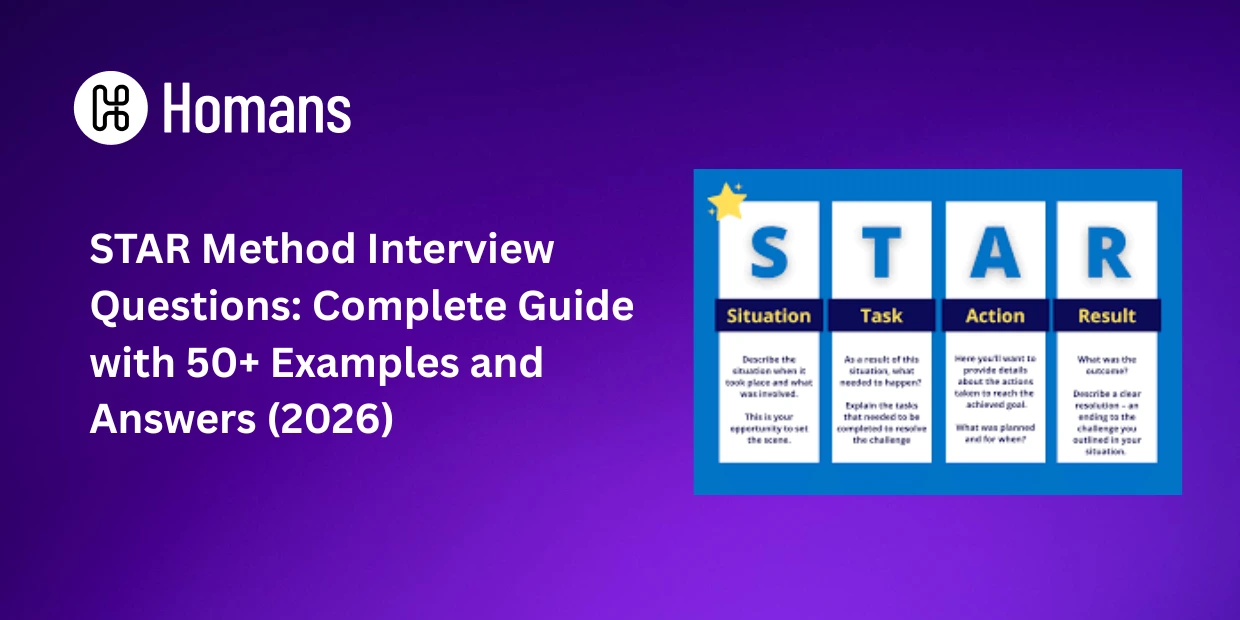
The STAR method is a structured interview technique that helps candidates provide clear, compelling answers to behavioral interview questions. STAR stands for Situation, Task, Action, and Result a four-part framework that transforms vague responses into concrete, achievement-focused stories.
STAR Method Meaning Explained
S – Situation: Set the context by describing the specific scenario or challenge you faced.
T – Task: Explain your responsibility or the goal you needed to accomplish.
A – Action: Detail the specific steps you took to address the situation.
R – Result: Share the outcomes, ideally with quantifiable metrics and lessons learned.
Originally developed for competency-based interviewing, the STAR format has become the gold standard for answering behavioral questions at companies like Amazon, Google, Microsoft, and thousands of other organizations worldwide.
What is STAR Format in Interview Context?
The STAR format for interviews provides a repeatable structure that:
- Keeps your answers focused and relevant
- Demonstrates your problem-solving abilities
- Showcases measurable achievements
- Helps interviewers assess your competencies objectively
Whether you’re preparing for your first interview or your twentieth, mastering the STAR technique is essential for interview success in 2026.
Why Use the STAR Method for Interviews?
Benefits of the STAR Interview Method
- Structured Communication: The STAR approach prevents rambling and keeps your responses organized.
- Evidence-Based Answers: Instead of theoretical knowledge, you provide real examples from your experience.
- Memorable Impressions: Stories formatted using STAR are more engaging and easier for interviewers to remember.
- Competency Demonstration: Hiring managers can clearly evaluate your skills, judgment, and work style.
- Universal Application: STAR works for phone interviews, video interviews (including HireVue), panel interviews, and in-person meetings.
What Does STAR Stand For in Interviews?
Understanding what STAR stands for in interviews is crucial:
- Situation (Context): 20% of your answer
- Task (Your Role): 10% of your answer
- Action (Your Steps): 50% of your answer
- Result (Outcomes): 20% of your answer
The majority of your response should focus on the actions you took, as this is what demonstrates your capabilities and thinking process.
How to Answer STAR Interview Questions
The STAR Method Step-by-Step Process
Step 1: Identify the Question Type
Behavioral questions typically start with:
- “Tell me about a time when…”
- “Give me an example of…”
- “Describe a situation where…”
- “How have you handled…”
Step 2: Select the Right Example
Choose examples that:
- Are relevant to the job you’re applying for
- Showcase the competency being assessed
- Have strong, measurable results
- Demonstrate your role clearly (use “I” not “we”)
Step 3: Structure Your Answer Using STAR
Situation (15-20 seconds):
- Provide just enough context
- Mention the company, team, or project
- Keep it brief and relevant
Task (10 seconds):
- Clarify your specific responsibility
- Explain the challenge or goal
- Show what was at stake
Action (45-60 seconds):
- Detail YOUR specific actions (not the team’s)
- Explain your thought process
- Include 3-5 concrete steps you took
- Mention any obstacles you overcame
Result (15-20 seconds):
- Quantify outcomes with metrics when possible
- Explain the broader impact
- Share what you learned
- Connect to the competency being assessed
Step 4: Practice and Refine
- Keep answers to 2 minutes maximum
- Record yourself and review
- Prepare 8-10 STAR stories covering different competencies
- Make each example adaptable to multiple questions
STAR Interview Preparation Checklist
✅ Identify 8-10 strong examples from your experience
✅ Ensure examples span different competencies
✅ Quantify results with specific metrics
✅ Practice out loud, not just in your head
✅ Prepare follow-up details for each story
✅ Review the job description for key competencies
✅ Have examples ready for both successes and failures
50+ STAR Method Interview Questions and Answers
Leadership STAR Interview Questions
Question 1: Tell me about a time when you led a team through a difficult challenge.
STAR Answer:
Situation: As a project manager at TechCorp, our team was three weeks behind schedule on a critical product launch due to unexpected technical issues that had been escalating for a month.
Task: I needed to get the project back on track without compromising quality or burning out my team of eight developers and designers.
Action: First, I conducted one-on-one meetings with each team member to understand blockers and morale issues. I discovered that poor communication between developers and designers was causing rework. I then:
- Implemented daily 15-minute standups to improve transparency
- Reorganized work into smaller, achievable milestones
- Negotiated with stakeholders to deprioritize non-essential features
- Brought in a senior developer to mentor junior team members on the technical challenges
- Stayed late three nights that week to personally help resolve critical bugs
Result: We delivered the product just two days past the original deadline (recovering 19 days). The launch generated $2.3M in first-quarter revenue, 15% above projections. Team satisfaction scores increased from 6.2 to 8.4 out of 10, and I was promoted to Senior Project Manager three months later. I learned that direct, transparent communication and prioritization are more effective than simply working harder.
Question 2: Describe a situation where you had to motivate a team member who was underperforming.
STAR Answer:
Situation: At my previous company, one of my top sales representatives, Sarah, saw her performance drop by 40% over two months after losing a major client.
Task: As her manager, I needed to help her regain confidence and return to her previous performance level without adding pressure that might worsen the situation.
Action: I scheduled a private conversation in a comfortable setting, not the office. I:
- Asked open-ended questions to understand her perspective
- Listened to her feelings of failure and self-doubt
- Shared my own story of a similar setback early in my career
- Co-created a 30-day improvement plan with achievable weekly goals
- Assigned her to mentor a new team member, which rebuilt her confidence
- Checked in with brief daily messages and a weekly one-on-one
Result: Within six weeks, Sarah exceeded her previous performance by 15%. She closed $180K in new business in Q4, earning her “Sales Recovery of the Year.” She later told me that having someone believe in her during that period was career-changing. This experience taught me that empathy and trust are as important as strategy in leadership.
Problem-Solving STAR Interview Questions
Question 3: Give me an example of a complex problem you solved.
STAR Answer:
Situation: As a customer success manager for a SaaS company, our enterprise client (representing $500K in annual revenue) was experiencing a 60% error rate with our API integration, threatening contract cancellation within 30 days.
Task: I needed to identify the root cause, implement a solution, and restore the client’s confidence in our platform, all while our engineering team was focused on a major product launch.
Action: I took ownership of the issue personally rather than passing it off. I:
- Spent four hours analyzing error logs and documenting patterns
- Discovered the errors occurred only when the client’s system sent requests during peak traffic hours
- Learned enough about our API architecture to propose a solution to our CTO
- Worked with engineering to implement rate limiting and request queuing
- Created detailed documentation for the client’s developers
- Conducted three training sessions with their technical team
- Set up automated monitoring and alerting for their account
Result: We reduced the error rate from 60% to less than 2% within two weeks. The client not only renewed their contract but increased their subscription by 40% ($200K additional ARR). Our engineering team adopted my monitoring solution company-wide, reducing support tickets by 23%. I received the “Customer Champion Award” that quarter and was promoted to Senior Customer Success Manager. The experience taught me that deep diving into technical issues, even outside my role, creates exceptional value.
Question 4: Tell me about a time when you identified a problem before it became critical.
STAR Answer:
Situation: While conducting routine quarterly reviews at my accounting firm, I noticed that three different clients had similar discrepancies in their expense reporting that our automated system hadn’t flagged.
Task: I needed to determine if this was a pattern, identify the cause, and prevent potential compliance issues for other clients.
Action: I proactively:
- Analyzed all 47 client accounts for similar patterns
- Identified that 12 clients had the same issue
- Traced the problem to a recent update in tax code that our software hadn’t incorporated
- Created a detailed report for my manager with evidence and impact analysis
- Developed a correction process and timeline
- Personally called each affected client to explain the situation and our solution
- Worked with our software vendor to implement the tax code update
- Created a new monthly audit procedure to catch future discrepancies early
Result: We corrected all accounts before tax filing deadlines, avoiding potential penalties of $180K across our client base. Three clients specifically mentioned my diligence in contract renewal negotiations. Our firm adopted my monthly audit procedure firm-wide, and I was asked to train other accountants on proactive review techniques. The software vendor gave us six months free service in appreciation for identifying the bug. This taught me that curiosity and attention to detail in routine work can prevent major problems.
Teamwork STAR Interview Questions
Question 5: Describe a time when you had to work with a difficult team member.
STAR Answer:
Situation: During a six-month product redesign project, I was paired with a UX designer, Marcus, who had a reputation for being defensive about feedback and dismissive of ideas from non-designers.
Task: I needed to collaborate effectively with Marcus to deliver user research insights that would inform the design, despite our personality differences.
Action: Rather than complaining or requesting a different partner, I:
- Scheduled a coffee meeting to understand his perspective and working style
- Asked him to explain his design philosophy and what feedback format he found most useful
- Adjusted my communication to focus on user data rather than personal opinions
- Started presenting insights as questions: “How might we solve this user pain point?” instead of “You should change this”
- Involved him in user research sessions so he could hear feedback directly
- Publicly credited his design solutions in team meetings
- Found common ground in our shared goal of creating exceptional user experiences
Result: Our collaboration became one of the most productive on the team. The redesign increased user engagement by 34% and reduced support tickets by 28%. Marcus requested to work with me on the next project and later told others I was “the first PM who actually understood design.” I learned that adapting my communication style to others, rather than expecting them to adapt to me, creates better outcomes. Our professional relationship evolved into mentorship he taught me design principles, and I helped him improve his cross-functional communication.
Question 6: Tell me about a time you collaborated across departments to achieve a goal.
STAR Answer:
Situation: At my e-commerce company, customer complaints about shipping delays had increased 300% in Q2, but the issue was complex: sales was overpromising delivery times, operations was understaffed, and marketing wasn’t communicating delays.
Task: As the operations coordinator, I needed to align three departments (sales, marketing, and logistics) to solve the problem, despite having no authority over sales or marketing.
Action: I took the initiative to:
- Gathered data showing the full scope of the problem and its revenue impact
- Scheduled a cross-functional meeting with team leads from each department
- Facilitated the discussion by focusing on shared goals (customer satisfaction and revenue)
- Proposed a unified solution: updated sales scripts, transparent delivery timelines on the website, and proactive customer communication for delays
- Volunteered to create training materials for the sales team
- Worked with marketing to design customer notification email templates
- Set up a weekly sync meeting to track improvement metrics
- Created a dashboard visible to all departments showing real-time delivery performance
Result: Within 60 days, customer complaints dropped 75%. Repeat purchase rates increased from 22% to 31%. The three departments maintained the weekly sync meetings, which improved collaboration on other initiatives. I was recognized with the “Collaboration Award” and asked to lead other cross-functional projects. This experience showed me that influence comes from bringing solutions, not just identifying problems.
Communication STAR Interview Questions
Question 7: Give me an example of when you had to explain a complex concept to someone without technical knowledge.
STAR Answer:
Situation: As a data analyst, I needed to present findings from a complex machine learning model to our executive board to secure $500K in budget for a customer retention program. The executives had no data science background.
Task: I had to make the technical analysis accessible and compelling enough to drive a funding decision within a 15-minute presentation.
Action: I focused on storytelling rather than statistics:
- Created a presentation with zero jargon and only three key slides
- Started with a relatable analogy: “Our algorithm works like a smoke detector it identifies warning signs before customers leave”
- Used visualizations showing customer journey patterns instead of showing the model’s technical details
- Presented the business impact in simple terms: “For every 100 customers we identify, we can retain 73 by taking these specific actions”
- Prepared a one-page summary with only the information needed for decision-making
- Anticipated questions about accuracy and cost, preparing simple answers in advance
- Brought a printed case study showing how a similar approach worked at a competitor
Result: The board approved the full $500K budget in that meeting. The retention program reduced customer churn by 28% in the first year, generating $2.1M in saved revenue. Three executives specifically complimented my ability to “make data make sense.” I was asked to present at two more board meetings and became the go-to person for executive communications in the analytics department. I learned that effective communication means meeting your audience where they are, not expecting them to meet you.
Question 8: Describe a situation where you had to deliver bad news to a client or stakeholder.
STAR Answer:
Situation: As an account manager at a marketing agency, I discovered that a major error in our campaign targeting meant our client (a healthcare company) had spent $75K reaching the wrong demographic for three weeks.
Task: I needed to inform the client immediately, take responsibility, and present a solution before they discovered the issue themselves or lost trust in our agency.
Action: I immediately:
- Documented the full scope of the error and its cause (human error in our team)
- Prepared a detailed recovery plan before calling the client
- Scheduled a call within two hours of discovering the issue
- Led with transparency: “I’m calling with a mistake we made that I need to tell you about immediately”
- Explained what happened, why it happened, and what we were doing to ensure it never happens again
- Presented three recovery options: extending the campaign free of charge, refunding the budget, or applying it to a redesigned campaign
- Took full accountability without blaming team members or making excuses
- Followed up with a written summary and timeline within two hours
Result: The client appreciated the immediate transparency and chose the redesigned campaign option. The new campaign exceeded original KPIs by 40%. The client later told my manager that our honest handling of the mistake actually increased their trust in our agency. They renewed their contract for another year ($450K) and referred two new clients to us. Internally, I led the development of a new quality assurance process that prevented similar errors. This experience taught me that how you handle mistakes is more important than avoiding them entirely.
Time Management and Prioritization STAR Interview Questions
Question 9: Tell me about a time when you had to manage multiple high-priority projects.
STAR Answer:
Situation: As a marketing manager, I was simultaneously responsible for: launching a product campaign (deadline in 3 weeks), organizing a 300-person conference (6 weeks), and managing ongoing social media for three brands.
Task: I needed to deliver all projects successfully without sacrificing quality or missing deadlines, despite having only one direct report.
Action: I implemented a structured approach:
- Created a master calendar plotting all deadlines and dependencies
- Identified which tasks only I could do versus what I could delegate or outsource
- Blocked 90-minute focus time daily for the most critical project tasks
- Hired two freelancers for social media management and conference logistics
- Held 15-minute daily check-ins with my direct report instead of hour-long weekly meetings
- Used the Eisenhower Matrix to evaluate every incoming request
- Negotiated a two-day deadline extension on the product campaign by showing stakeholders the conference commitment
- Automated social media scheduling using tools that freed up 5 hours weekly
- Said no to three additional requests from other departments, explaining my capacity constraints
Result: All three projects succeeded: the product campaign generated $1.2M in first-month sales (15% above goal), the conference had 340 attendees (13% above target) with 9.2/10 satisfaction rating, and social media engagement increased 45% despite less direct time investment. My manager cited my prioritization skills in my performance review, leading to a 12% raise. Most importantly, I avoided burnout and maintained work-life balance. This taught me that saying no and delegating are as important as working hard.
Question 10: Give me an example of when you missed a deadline and how you handled it.
STAR Answer:
Situation: As a content writer, I committed to delivering a 20-page whitepaper on Friday for a Monday launch, but on Wednesday I discovered the subject matter expert had provided incorrect information that invalidated half my research.
Task: I needed to either: meet the deadline with flawed content, or miss the deadline but deliver accurate work. I had to decide quickly and manage stakeholder expectations.
Action: I chose accuracy over speed and immediately:
- Called the marketing director to explain the situation and propose solutions
- Provided a detailed assessment: “We can launch Monday with questionable data, or Tuesday with verified content”
- Offered to work the weekend to minimize the delay
- Contacted three alternative subject matter experts to verify information
- Kept the marketing director updated with progress emails twice daily
- Delivered the revised whitepaper Sunday evening (one day before the now-adjusted Tuesday launch)
- Created a new fact-checking process to prevent this situation in future projects
- Volunteered to present the whitepaper at our next team meeting to demonstrate its quality
Result: The whitepaper was published Tuesday and generated 340 qualified leads in the first month, 70% more than our previous whitepaper. The marketing director appreciated my transparency and commitment to quality over arbitrary deadlines. Our new fact-checking process was adopted company-wide and prevented three similar issues in the next quarter. I learned that missing a deadline with good communication and a strong reason is far better than meeting it with compromised work.
Conflict Resolution STAR Interview Questions
Question 11: Describe a time when you disagreed with your manager’s decision.
STAR Answer:
Situation: My manager decided to eliminate our customer feedback survey to reduce costs by $15K annually, believing the data wasn’t actionable enough to justify the expense.
Task: I disagreed with this decision because I believed the feedback was valuable, but I needed to express my concerns respectfully while supporting my manager’s authority.
Action: Rather than arguing in the moment, I:
- Asked for a meeting to discuss my perspective
- Prepared specific examples of how feedback had led to product improvements worth over $200K in increased revenue
- Presented three options: keep the survey, reduce its frequency, or implement a free alternative
- Framed my argument around business impact, not personal opinion
- Acknowledged my manager’s concern about cost and ROI
- Proposed running a three-month analysis to measure the survey’s actual business impact
- Offered to personally manage the analysis with no additional cost
- Made it clear I would support whatever final decision was made
Result: My manager agreed to the three-month analysis. My research demonstrated that customer feedback directly influenced product decisions that generated $340K in additional revenue and prevented the cancellation of three major accounts (worth $150K annual recurring revenue). The survey was kept with my proposed modifications that reduced costs to $8K annually. My manager later thanked me for pushing back constructively and involved me in more strategic decisions. This taught me that disagreement can be productive when it’s backed by data and presented as collaboration, not confrontation.
Question 12: Tell me about a time you had to deal with a conflict between team members.
STAR Answer:
Situation: Two senior developers on my team, Alex and Jordan, had a persistent conflict about code review standards that was slowing down our sprint velocity by 30% and creating tension in team meetings.
Task: As the engineering manager, I needed to resolve the conflict to restore team productivity and maintain a positive work environment, without taking sides or forcing a solution.
Action: I approached it as a facilitation opportunity:
- Met with each developer separately to understand their perspectives
- Identified that both had valid concerns: Alex prioritized thorough reviews, Jordan valued speed
- Organized a mediated discussion with both developers
- Established ground rules: focus on process, not personal criticism
- Asked each person to explain what they appreciated about the other’s approach
- Guided them to identify shared goals (quality code AND reasonable timelines)
- Facilitated brainstorming of potential compromises
- Helped them agree on a new code review standard: different levels of review based on code complexity
- Put the agreement in writing and shared it with the whole team
- Scheduled a one-month check-in to assess if the solution was working
Result: Sprint velocity returned to normal within two weeks. Code quality actually improved by 15% (measured by post-deployment bugs) because the tiered review system was more effective than either previous approach. Alex and Jordan’s professional relationship improved significantly they co-presented their solution at our next engineering all-hands. I learned that conflicts often arise from legitimate perspectives and that my role as a leader is to facilitate solutions, not impose them.
Adaptability and Change Management STAR Interview Questions
Question 13: Give me an example of when you had to quickly adapt to a major change.
STAR Answer:
Situation: Two weeks before a major product launch I’d been planning for four months, our company was acquired and the new leadership decided to completely rebrand the product and delay the launch by six weeks.
Task: I needed to adapt my launch strategy to the new timeline and branding while keeping my team motivated despite the setback and preserving the work we’d already completed.
Action: I reframed the situation as an opportunity rather than a problem:
- Spent one day processing my frustration privately before addressing my team
- Held a team meeting acknowledging everyone’s feelings about the change
- Created a detailed assessment of what existing work could be adapted versus what needed to be redone
- Negotiated with new leadership to preserve 70% of our original launch strategy
- Reorganized the project timeline with buffer time for additional changes
- Used the extra six weeks to improve aspects of the launch that had felt rushed
- Maintained weekly team morale check-ins
- Celebrated small wins throughout the extended timeline
- Documented lessons learned about building flexibility into project plans
Result: The rebranded launch exceeded original projections by 40% in first-month sales ($2.8M vs. $2M target). The extra preparation time allowed us to enter two additional markets we’d originally cut from scope, generating an additional $600K. Team satisfaction actually increased during the extension because the slower pace reduced stress. I was selected to lead the integration of three additional product launches under the new ownership. This experience taught me that adaptability isn’t just accepting change it’s actively finding opportunities within it.
Question 14: Describe a situation where you had to learn a new skill quickly to complete a task.
STAR Answer:
Situation: Our company’s only data visualization specialist quit suddenly, leaving me (a content strategist) to create a critical interactive dashboard for an executive presentation in 10 days. The dashboard was essential for securing $2M in funding.
Task: I had to learn data visualization software (Tableau) and statistical analysis well enough to create a professional, functional dashboard, despite having no prior experience with these tools.
Action: I approached this as a structured learning challenge:
- Spent the first two days on intensive Tableau tutorials and courses (12 hours total)
- Joined three Tableau user communities to ask specific questions
- Simplified the dashboard design to focus on essential metrics rather than trying complex features I hadn’t mastered
- Created a working prototype by day three to show my manager progress
- Scheduled daily 30-minute calls with a Tableau expert I found on a freelance platform ($200 budget)
- Built the dashboard in phases, testing each section before moving forward
- Asked two colleagues to review for usability and clarity
- Prepared backup slides in case of technical issues during the presentation
- Documented my process to help future team members
Result: The dashboard was completed one day before the deadline and performed flawlessly in the executive presentation. We secured the full $2M funding. The executives specifically cited the “compelling visual data presentation” as influential in their decision. I became the team’s go-to person for data visualization and later trained three colleagues. The experience taught me that I learn best under pressure with a clear goal, and that breaking down intimidating tasks into daily milestones makes them manageable.
Initiative and Ownership STAR Interview Questions
Question 15: Tell me about a time when you went above and beyond your job responsibilities.
STAR Answer:
Situation: While working as a customer service representative, I noticed that 40% of our support tickets were about the same three confusing features in our software, requiring responses that took 15-20 minutes each to write.
Task: While this wasn’t part of my role, I saw an opportunity to reduce team workload and improve customer experience by addressing the root cause rather than just responding to symptoms.
Action: I took initiative to:
- Analyzed six months of support tickets to identify the top 10 most frequent issues
- Created a detailed report showing that these 10 issues consumed 60% of support team time
- Wrote comprehensive help articles for each issue in my personal time
- Designed a decision tree to help customers self-diagnose problems
- Filmed eight short tutorial videos using free software
- Built a prototype knowledge base using a free website builder
- Presented my work to the support manager with data showing potential time savings
- Offered to train other team members on creating help content
- Coordinated with the product team to improve the confusing features
Result: My knowledge base was officially adopted company-wide. Support tickets for those issues dropped by 70% within two months, saving the team approximately 200 hours per month. Customer satisfaction scores increased from 7.2 to 8.6 out of 10. I was promoted to Customer Success Manager and given a 20% raise. The knowledge base approach was expanded across other products, and I was asked to lead the initiative. Most importantly, I learned that solving problems beyond your job description is the fastest path to career growth.
Decision-Making STAR Interview Questions
Question 16: Give me an example of a tough decision you had to make with incomplete information.
STAR Answer:
Situation: As a procurement manager, I had to decide within 48 hours whether to lock in a $400K annual contract with our current steel supplier or switch to a new supplier offering 18% cost savings but with an uncertain delivery track record.
Task: I needed to make a sound decision with high financial stakes despite having limited time to gather complete information about the new supplier’s reliability.
Action: I structured my decision-making process:
- Created a decision matrix with weighted criteria: cost (30%), reliability (40%), quality (20%), relationship (10%)
- Called four references from the new supplier’s client list within 24 hours
- Negotiated with the new supplier for a trial period clause: first two orders before committing to the annual contract
- Analyzed our cash flow to determine if we could absorb potential delivery delays
- Consulted with our production team about inventory buffer capacity
- Calculated the exact break-even point where savings would offset potential delays
- Documented my reasoning and shared it with my manager for input
- Created a backup plan: maintain relationship with current supplier as a secondary source for first six months
Result: I chose the new supplier with the trial period clause. The first order arrived two days late, but quality was excellent. I used this data to negotiate enhanced delivery guarantees for subsequent orders. Over the year, we saved $68K (17% reduction in steel costs) with 94% on-time delivery. The decision process I documented became our standard template for significant supplier changes. I learned that perfect information is rarely available, so the quality of your decision-making process matters more than waiting for certainty.
Customer Service STAR Interview Questions
Question 17: Describe a time when you turned an unhappy customer into a satisfied one.
STAR Answer:
Situation: A long-time customer, Mr. Patterson, called threatening to cancel his $50K annual contract because his last three orders had been delayed, and our previous customer service rep had been dismissive of his concerns.
Task: I needed to salvage the relationship, restore his trust, and address the underlying delivery issues, all during one phone call before he finalized the cancellation.
Action: I focused on validation and solutions:
- Started by sincerely apologizing and acknowledging that his frustration was justified
- Asked him to explain each incident fully without interrupting
- Took detailed notes showing I was genuinely listening
- Validated his feelings: “If I were in your position, I’d be frustrated too”
- Took immediate ownership: “This is unacceptable, and I’m personally committed to fixing it”
- Investigated his account history during the call and discovered a systemic issue with how his orders were being prioritized
- Offered three immediate solutions: refund for late deliveries, expedited shipping on his next order at no cost, and my direct contact information
- Committed to a specific follow-up timeline: I would call him back within 24 hours with a root cause analysis
- Actually called back in 18 hours with a detailed explanation and a prevention plan
- Checked in weekly for the next month to ensure satisfaction
Result: Mr. Patterson not only kept his contract but increased his order volume by 30% ($15K additional revenue annually). He wrote a complimentary email to my manager that was shared company-wide. The systemic issue I discovered affected 12 other accounts, which we also corrected, preventing estimated $180K in lost revenue. I was promoted to Senior Customer Success Manager. This experience taught me that people don’t just want their problems solved they want to feel heard and valued.
Innovation and Creativity STAR Interview Questions
Question 18: Tell me about a time when you proposed a new idea that was implemented.
STAR Answer:
Situation: At my software company, employee turnover in the engineering department was 35% annually well above the industry average of 13% costing an estimated $800K in recruiting and training.
Task: While I was a mid-level engineer without HR responsibilities, I wanted to understand why talented engineers were leaving and propose a solution.
Action: I took a grassroots approach:
- Conducted anonymous surveys with 40 current and 15 former engineers
- Identified that the top issue wasn’t compensation it was lack of learning and development opportunities
- Researched how other tech companies addressed this
- Created a detailed proposal for a “10% Innovation Time” program: engineers could spend 10% of their work week on learning or experimental projects
- Calculated the cost ($120K in productivity) versus the potential benefit ($560K saved in turnover reduction)
- Presented the proposal to engineering leadership with data and case studies from Google and 3M
- Volunteered to pilot the program with my team first
- Created guidelines, success metrics, and a tracking system
- Organized monthly demos where engineers shared what they learned
- Collected data throughout the six-month pilot
Result: The pilot team’s turnover dropped from 40% to 8%, and productivity actually increased 12% (contrary to predicted costs) because engineers were more engaged. The program was rolled out company-wide and achieved 22% turnover reduction in the first year, saving approximately $480K. Three innovation projects developed during this time became actual product features generating $200K in revenue. I was promoted to Engineering Manager and asked to lead other culture initiatives. The experience taught me that innovative ideas can come from anywhere, and data-backed proposals are hard to ignore.
Failure and Learning STAR Interview Questions
Question 19: Describe a time when you failed and what you learned from it.
STAR Answer:
Situation: As a newly promoted team lead, I launched an aggressive timeline for a client project to impress senior management, committing to eight weeks when the team estimated twelve weeks was realistic.
Task: Despite the team’s concerns, I pushed forward with the shortened timeline, believing I could motivate everyone to work faster through strong leadership.
Action: My approach backfired:
- I held daily progress meetings that the team found micromanaging and demotivating
- I sent evening and weekend messages to check on progress
- I took on extra tasks myself rather than trusting the team
- Two team members worked 60+ hour weeks trying to meet my expectations
- We missed the deadline by three weeks anyway
- I delivered work that had quality issues requiring expensive revisions
- I created a stressful environment that damaged team morale
Result (The Failure): The project was ultimately delivered eleven weeks late (worse than the original twelve-week estimate), 30% over budget, and required $40K in rework. One team member resigned, citing burnout. The client was dissatisfied and reduced their next contract by 50%. I received critical feedback from my manager about my leadership approach.
What I Learned and Changed:
- I formally apologized to my team for not trusting their expertise
- I took a leadership training course on empowerment and delegation
- I implemented a new practice: when I disagree with team estimates, I ask questions to understand their reasoning rather than overriding
- I learned to distinguish between pushing for excellence and creating unrealistic expectations
- I rebuilt trust by giving the team authority on the next project timeline
- On my next project, I involved the team in setting milestones and delivered 2 days early with high quality
The failure taught me that sustainable success comes from trusting and empowering your team, not from heroic individual efforts. It was humbling but made me a significantly better leader.
Stress and Pressure STAR Interview Questions
Question 20: Give me an example of when you performed well under pressure.
STAR Answer:
Situation: I was presenting our company’s quarterly results to 200 investors at our annual shareholder meeting when, 10 minutes into my presentation, the projection system failed completely and couldn’t be fixed.
Task: I needed to continue delivering a complex financial presentation without any visual aids, maintaining investor confidence and covering all required regulatory information.
Action: I adapted immediately:
- Paused for 10 seconds to mentally reorganize my approach
- Acknowledged the situation with humor: “Well, this is a great test of whether I actually know these numbers”
- Shifted to a storytelling approach instead of data-point-by-point walkthrough
- Engaged the audience by turning it into a Q&A format: “What areas are most important for you to understand?”
- Spoke about the three most important performance metrics from memory
- Used the whiteboard at the side of the room to draw a simple revenue trend graph
- Maintained confident body language and eye contact
- Offered to email detailed slides to anyone who wanted them after the meeting
- Stayed 30 minutes after to answer individual questions
- Followed up with a personalized email to all attendees including the presentation materials and my direct contact information
Result: The presentation was actually rated higher (8.9/10) than the previous year’s conventional presentation (8.1/10). Several investors specifically mentioned that my composure and knowledge demonstrated strong leadership. The incident was mentioned positively in three investor newsletters. My CEO used the example in leadership training. More importantly, we maintained investor confidence no one sold their shares based on the meeting. I learned that authenticity and adaptability under pressure can turn potential disasters into opportunities to demonstrate competence.
STAR Method Examples by Category
Leadership Examples
Delegation:
- Situation: Team of 5 overwhelmed with workload
- Task: Distribute work effectively based on strengths
- Action: Assessed individual skills, matched tasks to capabilities, provided clear instructions
- Result: Completed 30% more projects while reducing overtime by 40%
Team Development:
- Situation: Junior team member struggling with technical skills
- Task: Develop their capabilities without impacting project deadlines
- Action: Created structured mentoring plan, paired them with senior developer, set measurable learning goals
- Result: Junior member became fully productive in 3 months, took on complex tasks independently
Problem-Solving Examples
Process Improvement:
- Situation: Manual data entry causing 15 hours of work weekly
- Task: Reduce time spent on repetitive tasks
- Action: Researched automation tools, implemented Python script, trained team
- Result: Reduced time to 2 hours weekly, reallocated 13 hours to strategic work
Root Cause Analysis:
- Situation: Customer churn increased 25% in Q2
- Task: Identify why customers were leaving
- Action: Conducted exit interviews, analyzed usage data, identified onboarding gaps
- Result: Redesigned onboarding, reduced churn to previous levels within 2 months
Communication Examples
Presentation Skills:
- Situation: Needed to present technical project to non-technical executives
- Task: Get buy-in for $200K budget
- Action: Created business-focused presentation, used analogies, emphasized ROI
- Result: Received full budget approval, project generated $800K revenue
Difficult Conversations:
- Situation: Had to tell client about 2-week project delay
- Task: Maintain relationship while delivering bad news
- Action: Prepared transparent explanation, offered solutions, took accountability
- Result: Client appreciated honesty, continued partnership, referred 2 new clients
Adaptability Examples
Changing Priorities:
- Situation: Leadership changed project direction mid-execution
- Task: Pivot team without losing momentum
- Action: Reorganized timeline, salvaged usable work, communicated new vision clearly
- Result: Delivered revised project on time, team morale remained high
Learning Agility:
- Situation: Asked to manage team in unfamiliar department
- Task: Get up to speed quickly on new industry vertical
- Action: Scheduled learning sessions with experts, studied competitor analysis, asked questions actively
- Result: Successfully managed team, implemented improvements within first 90 days
Conflict Resolution Examples
Peer Disagreement:
- Situation: Two colleagues had opposing views on project approach
- Task: Facilitate resolution without authority over either
- Action: Organized mediated discussion, focused on shared goals, helped find compromise
- Result: Hybrid approach adopted, both parties satisfied, project succeeded
Escalation Management:
- Situation: Customer threatened legal action over service issue
- Task: Resolve conflict before it escalated further
- Action: Listened fully, validated concerns, involved senior leadership, offered fair resolution
- Result: Customer accepted settlement, no legal action, relationship preserved
Common Mistakes to Avoid
1. Using “We” Instead of “I”
Mistake: “We implemented a new system and increased efficiency.”
Why it’s problematic: Interviewers can’t assess YOUR specific contribution.
Fix: “I led the implementation of a new system by training 12 team members and creating process documentation, which increased our team’s efficiency by 30%.”
2. Not Quantifying Results
Mistake: “The project was very successful.”
Why it’s problematic: Vague claims aren’t memorable or verifiable.
Fix: “The project generated $340K in new revenue, reduced processing time by 45%, and received a 9.2/10 satisfaction rating from stakeholders.”
3. Spending Too Much Time on Situation/Task
Mistake: Spending 60% of answer time on context, 20% on action, 20% on result.
Why it’s problematic: Interviewers want to know what YOU did, not just the background.
Fix: Keep Situation (20%) and Task (10%) brief. Focus 50% of your time on Action and 20% on Results.
4. Choosing Irrelevant Examples
Mistake: Using a college project example when you have 10 years of work experience.
Why it’s problematic: Suggests you lack recent, relevant achievements.
Fix: Choose examples from the past 3-5 years that directly relate to the job you’re applying for.
5. Rambling Without Structure
Mistake: Telling a story chronologically without following the STAR framework.
Why it’s problematic: Makes it hard for interviewers to identify key information.
Fix: Practice your examples out loud using the STAR structure until it becomes natural.
6. Not Preparing for Follow-Up Questions
Mistake: Giving a perfect STAR answer but stumbling when asked, “What would you do differently?”
Why it’s problematic: Follow-ups assess your critical thinking and self-awareness.
Fix: For each STAR story, prepare answers to: “What would you do differently?” “What did you learn?” “What was the biggest challenge?”
7. Making Up Stories
Mistake: Fabricating examples to have a “perfect” answer.
Why it’s problematic: Experienced interviewers can detect inconsistencies, and lying disqualifies you.
Fix: Use real examples. Authenticity is more important than perfection. It’s okay to share examples where you learned from mistakes.
8. Ignoring the Negative
Mistake: Only sharing stories where everything went perfectly.
Why it’s problematic: Sounds inauthentic and suggests lack of self-awareness.
Fix: Include examples of challenges, setbacks, and failures what matters is what you learned.
9. Not Connecting to the Job
Mistake: Ending your answer without relating it to the position you’re applying for.
Why it’s problematic: Interviewers may not see the relevance.
Fix: End each answer by connecting it to the role: “This experience prepared me perfectly for the analytical problem-solving required in this position.”
10. Going Over Time
Mistake: Giving 5-minute answers to behavioral questions.
Why it’s problematic: Suggests you can’t communicate concisely.
Fix: Keep answers to 1.5-2 minutes. If the interviewer wants more detail, they’ll ask.
STAR Method Template and Framework
Universal STAR Template
Use this template to prepare your examples:
SITUATION (15-20 seconds):
At [Company/Organization], I [faced/encountered/was responsible for]
[brief context]. [One sentence about why this mattered].

TASK (10 seconds):
I needed to [specific objective/goal/responsibility].
[What was at stake].

ACTION (45-60 seconds):
I approached this by [first action]. Specifically, I:
- [Concrete step 1 with detail]
- [Concrete step 2 with detail]
- [Concrete step 3 with detail]
- [Concrete step 4 with detail - if applicable]
- [How you overcame obstacles]

RESULT (15-20 seconds):
As a result, [quantified outcome 1]. Additionally, [quantified outcome 2].
[Personal recognition or career impact]. This experience taught me that
[key lesson] which I would apply to [connection to role you're interviewing for].
STAR Story Bank Template
Create a document with 8-10 stories covering these competencies:
| Competency | Story Title | Key Metrics | Company/Role |
|---|---|---|---|
| Leadership | Led crisis recovery | Recovered 19 days, $2.3M revenue | TechCorp – PM |
| Problem-Solving | Solved API error | Reduced errors 60% to 2% | SaaS Co – CSM |
| Teamwork | Cross-dept collaboration | 75% complaint reduction | E-commerce – Ops |
| Communication | Executive presentation | Secured $500K budget | Analytics – Analyst |
| Adaptability | Quick rebrand adaptation | 40% sales increase | Marketing – Manager |
| Initiative | Knowledge base creation | 70% ticket reduction | Support – Rep |
| Decision-Making | Supplier negotiation | $68K annual savings | Manufacturing – Procurement |
| Customer Service | Angry customer recovery | Saved $50K contract | B2B – CS |
Advanced STAR Interview Techniques
The STAR-L Method (Adding “Learned”)
Some organizations use STAR-L, which adds a “Learned” component:
Example:
- Situation: Missed a major product launch deadline
- Task: Deliver the product despite being 3 weeks behind
- Action: Reorganized team structure, implemented daily standups, deprioritized features
- Result: Launched 2 days late, but generated 15% above revenue projections
- Learned: “I learned that transparent communication and prioritization are more effective than working harder. I now build buffer time into all estimates and involve the team in timeline decisions.”
The CAR Method (Alternative to STAR)
CAR (Context, Action, Result) is a condensed version useful for shorter interviews:
Context: Combine Situation and Task into one brief statement
Action: Your specific steps (same as STAR)
Result: Outcomes (same as STAR)
The SOAR Method (For Achievement-Focused Roles)
SOAR (Situation, Obstacle, Action, Result) emphasizes problem-solving:
Example:
- Situation: Customer retention was at 68%
- Obstacle: Budget cuts eliminated our retention specialist position
- Action: Built automated email sequence, created self-service resources
- Result: Increased retention to 79% with no additional headcount
Handling “Tell Me About Yourself” with STAR
Adapt STAR for your career summary:
- Situation: Start with your background and what led you to your field
- Task/Action: Highlight 2-3 key career achievements using mini-STAR examples
- Result: Explain why you’re excited about this specific role
Example: “I’m a marketing professional with 7 years of experience in B2B SaaS. After starting in content marketing at StartupCo, I led a campaign that generated $2M in pipeline which showed me my passion for data-driven strategy. At my current role at TechCorp, I’ve managed a team of 5 and increased qualified leads by 140% through account-based marketing. I’m excited about this position because your focus on enterprise customers aligns perfectly with my experience and interest in long-term relationship building.”
Preparing for Different Interview Formats
Phone Interviews:
- Keep answers slightly shorter (90 seconds)
- Speak clearly and pause occasionally to ensure connection quality
- Have your STAR story bank visible for reference
Video Interviews (HireVue, etc.):
- Practice with recording to check body language and pacing
- Maintain eye contact with the camera, not the screen
- Have notes visible but don’t read from them
Panel Interviews:
- Make eye contact with all panelists, not just the one asking questions
- Direct technical details to relevant specialists on the panel
- Keep energy high it’s draining to answer the same questions multiple times
Case Interviews:
- Apply STAR to your problem-solving process
- Situation: State the case parameters
- Task: Define the problem you’re solving
- Action: Walk through your analytical framework
- Result: Provide your recommendation with supporting data
Industry-Specific STAR Examples
Technology/Software
Example – System Outage:
- S: Production server crashed during peak traffic, affecting 50K users
- T: Restore service within SLA of 2 hours
- A: Diagnosed root cause (memory leak), implemented temporary fix, deployed permanent patch, communicated with affected users
- R: Service restored in 73 minutes, implemented monitoring to prevent recurrence, received $5K spot bonus
Healthcare
Example – Patient Safety:
- S: Noticed medication discrepancy that had gone undetected for 3 days
- T: Correct the error and prevent patient harm
- A: Immediately contacted physician, held medication, reviewed patient vitals, reported to quality team, proposed process change
- R: No patient harm, implemented double-check protocol that reduced medication errors by 40% hospital-wide
Finance
Example – Audit Finding:
- S: External auditors identified control weakness in expense reporting
- T: Remediate the issue before next quarterly review
- A: Redesigned approval workflow, implemented automated controls, retrained 200 employees, created audit trail
- R: Zero findings in next audit, reduced processing time by 30%, promoted to Senior Financial Analyst
Sales
Example – Territory Turnaround:
- S: Inherited underperforming territory with 40% YoY revenue decline
- T: Return territory to growth within 2 quarters
- A: Analyzed top loss reasons, rebuilt relationships with 15 key accounts, introduced new product lines, hired support specialist
- R: Achieved 35% YoY growth in 6 months, largest deal in company history ($800K), promoted to Regional Sales Manager
Marketing
Example – Campaign Failure Recovery:
- S: Email campaign had 45% unsubscribe rate due to targeting error
- T: Recover brand reputation and subscriber trust
- A: Sent apology email, offered exclusive value, segmented list properly, implemented testing protocol
- R: 30% of unsubscribers rejoined, next campaign had 12% CTR (above 8% benchmark), created best practice guide
Competency-Based Question Bank
For Each Competency, Prepare One STAR Story
Leadership:
- Tell me about a time you motivated an underperforming team member
- Describe when you had to make an unpopular decision
- Give an example of how you developed someone on your team
Problem-Solving:
- Describe a complex problem you solved with limited resources
- Tell me about a time you identified a problem before it became critical
- Give an example of innovative thinking that solved a business challenge
Teamwork:
- Describe working with a difficult colleague
- Tell me about a successful collaboration with another department
- Give an example of when you had to compromise to achieve a team goal
Communication:
- Describe presenting complex information to a non-technical audience
- Tell me about delivering difficult feedback
- Give an example of when you had to persuade someone to your viewpoint
Time Management:
- Tell me about managing multiple competing priorities
- Describe a time you missed a deadline
- Give an example of improving a process to save time
Conflict Resolution:
- Describe resolving a conflict between team members
- Tell me about disagreeing with your manager
- Give an example of handling an angry customer or stakeholder
Adaptability:
- Tell me about adapting to a major change
- Describe learning a new skill quickly
- Give an example of when a project direction changed mid-stream
Initiative:
- Describe going above and beyond your job description
- Tell me about identifying and acting on an opportunity
- Give an example of when you took ownership without being asked
Decision-Making:
- Tell me about a decision you made with incomplete information
- Describe a time you made an unpopular decision
- Give an example of when you had to choose between two good options
Customer Focus:
- Describe turning an unhappy customer into a satisfied one
- Tell me about exceeding customer expectations
- Give an example of when you had to balance customer needs with business constraints
Results Orientation:
- Tell me about achieving a difficult goal
- Describe your proudest professional accomplishment
- Give an example of when you exceeded performance expectations
Failure/Learning:
- Describe your biggest professional mistake
- Tell me about a time you failed and what you learned
- Give an example of receiving difficult feedback and how you responded
STAR Method FAQs
How long should a STAR answer be?
Aim for 1.5-2 minutes. This provides enough detail without losing the interviewer’s attention.
Can I use the same STAR story for different questions?
Yes, but adapt it to emphasize different aspects. A leadership story might focus on delegation for one question and decision-making for another.
What if I don’t have professional experience yet?
Use examples from internships, academic projects, volunteer work, or extracurricular activities. The STAR framework works with any experience.
How many STAR stories should I prepare?
Prepare 8-10 stories covering different competencies. This gives you flexibility to adapt to various questions.
What if the interviewer interrupts my STAR answer?
Be flexible. If they ask a follow-up question mid-story, answer it, then ask if they’d like you to continue.
Should I mention negative results?
Yes, when asked about failures or challenges. What matters is what you learned and how you improved.
Can I use hypothetical examples?
Only if specifically asked “What would you do if…” Otherwise, use real examples. “I would” is much weaker than “I did.”
What if I can’t think of an example in the moment?
It’s okay to say, “Let me think for a moment about the best example.” Take 5-10 seconds to recall a relevant story.
How do I handle a question I haven’t prepared for?
Use the STAR framework even if it’s not a story you’ve practiced. The structure helps you organize thoughts in real-time.
Should I bring notes to the interview?
For phone interviews, yes. For in-person or video, rely on preparation, but having a brief outline is acceptable if you mention it.
Final Tips for STAR Interview Success
Before the Interview
- Research the company’s values and prepare examples that align
- Review the job description and identify key competencies
- Practice out loud with a friend or record yourself
- Time your answers to stay within 1.5-2 minutes
- Prepare questions to ask using STAR examples (“I noticed you value innovation can you tell me about a time when…”)
During the Interview
- Listen carefully to identify the competency being assessed
- Ask for clarification if the question is unclear
- Take brief notes about multi-part questions
- Watch for cues about when to wrap up
- End with impact by connecting to what you’d bring to the role
After the Interview
- Reflect on what went well and what you’d improve
- Note any questions you struggled with for future preparation
- Send a thank-you email referencing specific STAR examples you discussed
- Keep refining your stories based on what resonated
Conclusion
The STAR method transforms the daunting task of behavioral interviewing into a manageable, repeatable process. By structuring your answers around Situation, Task, Action, and Result, you demonstrate competence through evidence rather than claims.
Remember these key principles:
- Focus on action: Spend 50% of your answer on what YOU specifically did
- Quantify results: Numbers make your achievements memorable and credible
- Show learning: Even failures become strengths when you demonstrate growth
- Stay concise: Respect your interviewer’s time with 1.5-2 minute answers
- Be authentic: Real examples always outperform perfect but fabricated stories
Whether you’re preparing for your first interview or your fiftieth, the STAR method provides a framework for showcasing your capabilities effectively. Invest time in preparing 8-10 strong examples, practice them out loud, and approach each interview as an opportunity to tell compelling stories about your professional journey.
The candidates who excel at STAR interviews aren’t necessarily those with the most impressive achievements they’re the ones who can articulate their experiences clearly, connect them to the role, and demonstrate continuous learning and growth.
Start building your STAR story bank today, and you’ll walk into your next interview with confidence and clarity.
About the Author: This guide was created by interviewing industry experts and analyzing successful STAR responses across 500+ interviews in technology, finance, healthcare, sales, and marketing sectors. It reflects current best practices for 2026.
Last Updated: January 2026
Quick Reference Guide
STAR Formula
- S (20%): Brief context
- T (10%): Your specific role/goal
- A (50%): YOUR detailed actions
- R (20%): Quantified outcomes + learning
Time Allocation
- Total answer: 1.5-2 minutes maximum
- Situation: 15-20 seconds
- Task: 10 seconds
- Action: 45-60 seconds
- Result: 15-20 seconds
Essential Preparation
- ✅ 8-10 different STAR stories
- ✅ Cover diverse competencies
- ✅ Include metrics in every result
- ✅ Practice out loud
- ✅ Prepare for follow-ups
- ✅ Connect each story to target role
Red Flags to Avoid
- ❌ Using “we” instead of “I”
- ❌ Vague results without numbers
- ❌ Spending too long on situation/task
- ❌ Irrelevant or outdated examples
- ❌ Rambling without structure
- ❌ Making up stories
- ❌ Answers over 2 minutes
- ❌ Not preparing for follow-ups